Handover
Stop paying to reload one giant chat. Short sessions that start from a handover file Claude Code loads by itself, a decisions log, and recall of earlier sessions.
npx -y github:nrzz/claude-code-handover initNineteen small, open-source tools. Each is a dependency-free Node command or plugin that adds few or no tokens to your sessions, and all nineteen are tested together, installed from GitHub, on Windows, macOS and Linux.
$ npx -y github:nrzz/claude-code-toolkitOpens a setup page with the recommended tools already switched on: one click on Install sets them up, and each tool's settings are there when you want them. Prefer Claude Code's plugins? /plugin marketplace add nrzz/claude-code-toolkit. Spendcap is in Anthropic's plugin directory: /plugin install spendcap@anthropic-plugin-directory
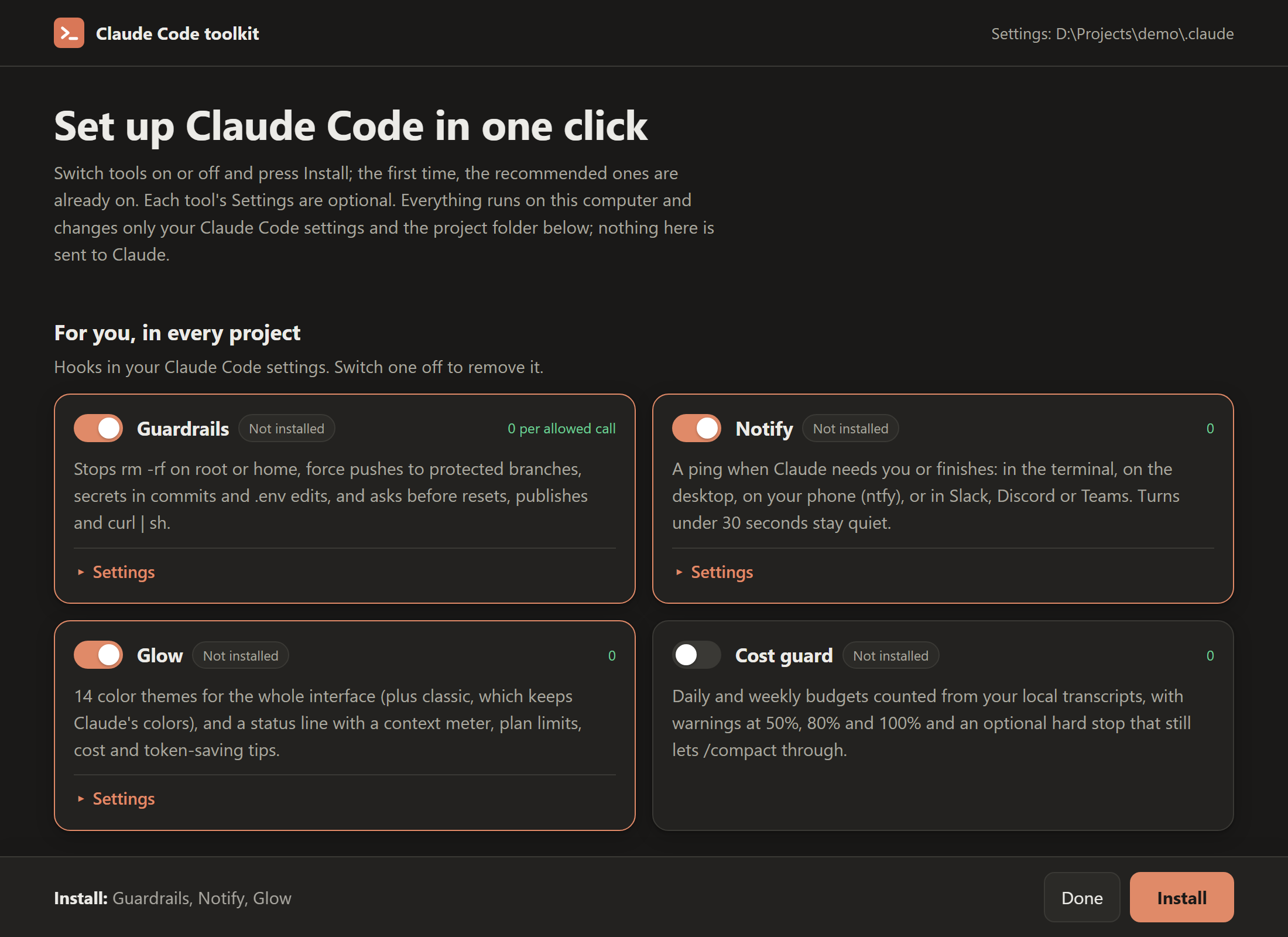
The green tag is what a tool adds to your sessions. Every README has a table with the details, and a section that says what was verified and how.
Stop paying to reload one giant chat. Short sessions that start from a handover file Claude Code loads by itself, a decisions log, and recall of earlier sessions.
npx -y github:nrzz/claude-code-handover initShare sessions, notes and team context with coworkers through git or a shared folder, synced in the background. Load a teammate's session by topic.
npx -y github:nrzz/claude-code-team-sync init14 themes that recolor the whole interface (and a classic one that keeps Claude's colors), a status line with a context meter and plan limits, and a live HUD with tips that help you spend fewer tokens.
/plugin install glowline@claude-code-toolkitStops rm -rf /, force pushes to protected branches, secrets in commits and .env edits, and asks before resets, publishes and curl | sh.
/plugin install guardrails@claude-code-toolkitA ping when Claude needs you or finishes: terminal, desktop, phone through ntfy, Slack, Discord, Teams or your own command. Short turns stay quiet.
/plugin install nudge@claude-code-toolkitDaily and weekly budgets counted from your local transcripts, warnings at 50%, 80% and 100%, and an optional hard stop that still lets /compact through.
/plugin install spendcap@claude-code-toolkitWhat your memory files cost in every session, what is stale or duplicated, and the fixes that save the most tokens. Runs in CI too.
npx -y github:nrzz/claude-md-doctorA lean CLAUDE.md, permission rules, /test and /check skills and a Haiku test runner for .NET, Node, Python, Go, Flutter or Java, in one command.
npx -y github:nrzz/claude-code-starter-kitsSearch everything you discussed in past sessions, and export one as a self-contained HTML replay or Markdown. --redact replaces secrets first, and the plugin's /replayer:replay always uses it.
npx -y github:nrzz/claude-session-replay listContinue a Cursor or Antigravity chat in Claude Code (claude --resume opens it with the whole chat as history), hand a Claude Code session to them, or turn any chat into Markdown or JSON. Reads Codex CLI, claude.ai and ChatGPT exports too.
npx -y github:nrzz/claude-chat-ferry import cursor:latestDelete, keep and restore your sessions before the 30-day cleanup removes them: a list with the day each one goes, a trash you can restore from, and a keep list that outlives the cleanup. Finds empty and orphaned sessions too.
npx -y github:nrzz/claude-session-tidy listSee why a permission prompt appeared: the rule that allowed, asked about or denied each part of a command, or the one rule that would stop it. Finds dead and hidden rules, and proposes rules from the commands that ran without one.
npx -y github:nrzz/claude-permission-doctor lintRun every hook of your setup with the exact JSON Claude Code sends for its event, and see what each one does: exit code, time, output, whether the output is valid for the event, and whether it blocks, allows or stays silent. Finds the misspelled event, the lowercase matcher and the missing script before anything runs.
npx -y github:nrzz/claude-hook-bench runMove Claude Code's config folder (settings, sessions, the plugin cache, .claude.json) to another drive or into the XDG folders. It writes CLAUDE_CONFIG_DIR into your shell profiles and the Windows user environment, keeps file times, refuses while Claude Code runs, and undo puts everything back.
npx -y github:nrzz/claude-relocate planComments for your settings: a settings.jsonc that builds settings.json. The settings Claude Code merges, with the file each key came from and which one wins, and a lint that finds the comment or trailing comma that makes Claude Code ignore a whole file, keys the schema does not know, wrong types and deprecated keys.
npx -y github:nrzz/claude-settings-doctor lintWhat auto mode and its classifier decided, read from your transcripts: who made each tool decision, the commands the classifier refused, and the refusals that were no verdict at all, the service rather than your settings. Its lint finds an autoMode list that drops the built-in rules because "$defaults" is missing, and why says whether a command goes to the classifier.
npx -y github:nrzz/claude-automode-doctor reportEvery MCP server Claude Code would load for the project, from which file and which definition wins, and whether a .mcp.json server is approved, pending or off. check starts each server the way Claude Code would, lists its tools and sizes them; the lint finds a command not on PATH, a ${VAR} set nowhere and a name in two scopes.
npx -y github:nrzz/claude-mcp-check showWhether Claude Code's Bash sandbox can work on this machine (bubblewrap, socat and user namespaces on Linux, seatbelt on macOS), the merged sandbox settings with their files, and why a command runs inside the sandbox, outside it, or not at all. Its lint finds the settings that never take effect, such as an allowedDomains entry with a scheme.
npx -y github:nrzz/claude-sandbox-doctor checkOn Windows: which shell the Bash tool will get and why, every claude on the machine and which one runs first, and the setup problems behind common Windows issues, such as Git Bash that Claude Code cannot find. fix --git-bash sets CLAUDE_CODE_GIT_BASH_PATH for you, and undo takes it out.
npx -y github:nrzz/claude-windows-doctor checkSo you can add one without wondering what it does to your machine, your settings or your bill.
Node 18 or newer and nothing from npm. There is nothing to audit but the code itself.
A hook speaks to the model only when that is its job, like a recalled line or the reason a command was stopped; the rest talks to you. Skills Claude does not need are user-only. Every README states what each part costs.
A backup before every write, only the keys each tool is there for, invalid JSON left alone, and an uninstall that takes out what it added.
Each says what was verified and how, and what was not. Each runs its tests on Windows, macOS and Linux with Node 20, 22 and 24, and on Linux with Node 18.
One end-to-end run does what a new user would, on a clean machine, and CI repeats it every week so a Claude Code update that breaks a tool shows up.
settings.json lists it, with the JSON Claude Code sends: guardrails denies rm -rf /, notify pings after a long turn, cost guard holds a prompt over a hard budget, two teammates share a session through one git remote, a replay escapes hostile text, session tidy keeps one old session and moves another to its trash and back byte for byte, permission doctor explains a prompt and finds a dead rule without changing a file, relocate moves a config folder and puts it back byte for byte, settings doctor finds the trailing comma that makes Claude Code ignore a whole file and builds settings.json from a commented settings.jsonc, auto mode doctor tells a classifier refusal from a refusal with no verdict, MCP check starts a server the way Claude Code would and sizes its tools, sandbox doctor tells a command its excludedCommands entry takes out of the sandbox from one that stays in it, windows doctor reports the shell Claude Code would give the model.claude plugin install, their own hooks run from the installed copies, their token estimate checked, the request Claude Code sends the model checked for their user-only skills, and the HUD's engine tests run inside Claude Code.settings.json checked to be exactly what the user had.The releases of 4 October come from an audit that checked every README against the code. Each tool's changelog lists every fix.
each command takes only the words it documents: a stray word such as budget clear daily, which cleared both limits, now stops it with exit 1 before anything is changed and suggests --daily; from an outside pull request, for a bug its author found.
each command takes only its own flags: a typo such as budget clear --dialy, which cleared both limits, now stops it with exit 1 before anything is changed and names the nearest flag; from an outside pull request, for an outside bug report.
install --scope project for Codex says that a project's hooks run only in a trusted project and how to trust it (codex exec --trust, or the entry in config.toml), following Codex CLI 0.169.0; 1.5.2 is 1.5.1 with its wording corrected and its checks green on every system.
corrects 1.2.0 on one point: before Codex 0.169.0 the hook-trust bypass did run an untrusted project's hooks in a danger-full-access run, which trusted the folder first; the check covers that run on both sides of 0.169.0.
cost counts the deferred tool namespaces that Codex 0.167.0 moved into the developer message, its figures are recorded from Codex 0.170.0 on every system, and lint and explain follow the project trust of Codex 0.169.0 (codex exec --trust).
the Copilot cache is the version folder only, and the pwsh.exe command line of Gemini CLI gains -NonInteractive, following Copilot CLI 1.0.106 and Gemini CLI 0.69.0.
show and why follow Claude Code 2.1.324, which turned an unset autoAllowBashIfSandboxed off: a sandboxed command now goes through the permission prompts unless the key is true, and both say so; the checks follow 2.1.317 to 2.1.328, and Ubuntu 26.04, where every sandboxed command fails, is recorded.
report reads what Claude Code 2.1.319 writes when the server's check does not reach the session, which now refuses every action that needs it with no fallback, and says what brings the check back; cost says when Claude Code makes its own classifier requests.
the real-binary check of the skill's hand-off follows Claude Code 2.1.318, which names the command that needed approval where 2.1.317 ended the turn in silence.
budget check exits 1 when budgets.json has a setting that cannot be read as written and 0 when every setting reads, with --json for scripts; from an outside pull request.
budget set --model and budget show suggest the nearest model for a name that matches nothing, from an outside pull request; and a hand-edited budgets.json is read as meant ("6", "Hard"), with every setting it cannot read named instead of dropped, from an outside bug report.
recall --project <folder> searches one other project's transcripts and notes without --all; from an outside pull request.
list and run --http warn when an http hook's header uses a variable that allowedEnvVars does not list, one warning per reference, and note an entry no header uses; from an outside pull request.
budget show notes each saved model budget whose name matches no model in your history, in the words budget set uses, so a typo saved before 1.2.0 no longer reads as a working limit at 0%; from an outside pull request, the third on this tool, opened half an hour after its issue.
recall names the --who and --since values that were on in its heading and its "No match" line, so an empty result no longer reads as if the topic never came up; from an outside pull request, the fourth on this tool, opened hours after its issue.
check and why keep what a server wrote to stderr right before it exited: the weekly real-binary run of 2 November lost it on a busy runner, because Node fires exit before the pipes are drained; the pipes are now read until they close.
recall --who you|claude|notes keeps only your messages, Claude's answers or the saved notes, together with --since, --all and --limit; from an outside pull request, the third on this tool.
budget set --model <name> notes when the name matches no model in your history and lists the models seen, so a typo no longer looks like a limit in force; from an outside pull request, the second on this tool.
stale-command checks task x in CLAUDE.md against Taskfile.yml (.yaml and .dist.yml too), with a near-miss suggestion, and stays silent for includes, -t, -d, --list and placeholders; from an outside pull request, the second on this tool.
stale-command checks pdm run, hatch run and poe tasks against pyproject.toml (inline tables and Hatch environments that inherit from default included), and stays silent for python, pip, a listed dependency or a tool in .venv; from the first outside pull request on this tool.
why --file <path> reads the commands to check from a text file, one per line, with blank lines and # comments skipped; from an outside pull request, the fourth on this tool.
Reads Gemini CLI sessions (gemini:latest, list --from gemini) and /chat share files, built from sessions recorded with Gemini CLI 0.64.0; from the first outside pull request on this tool.
A Rust kit: claude-starter detects Cargo.toml and sets up cargo build, test, clippy and fmt, with cargo publish denied; from the first outside pull request on this tool.
check --live reads each request of its fake APIs as UTF-8 across chunks: a folder with an accented name in the command line of the PowerShell that Gemini CLI or Copilot CLI started could be read as replacement characters, and Gemini CLI's run then said another PowerShell had started.
check --live reads each request of its fake API as UTF-8 across chunks, so an em dash of Claude Code's prompt that falls between two chunks is read whole; no verdict depended on it.
check --live reads each request of its fake API as UTF-8 across chunks, so an em dash of Claude Code's prompt that falls between two chunks is read whole; no verdict depended on it.
lint warns about a literal credential in a shared .mcp.json (a flag, env, a header or a URL) and never prints the value; from the first outside pull request on this tool.
check and show say whether the request carries the MCP tool schemas or only their names: from Claude Code 2.1.304 MCP tools wait behind tool search by default, and ENABLE_TOOL_SEARCH is read the way the binary reads it (38 values put to it).
lint --fail-on error|warn|note sets which findings make the exit code 1; from the first outside pull request on this tool.
Deny and ask rules match a program given by its path by its name, as Claude Code 2.1.309 and newer do (Bash(rm *) refuses /bin/rm and ./rm); found when the oracle put the table to Claude Code 2.1.312, and bisected to 2.1.309.
plan and status show the free space of the drive the config folder is on; from the first outside pull request on this tool.
why takes several commands and prints one verdict each, with one JSON document and the worst verdict as the exit code; from an outside pull request, the third on this tool.
recall --since narrows recall to recent work; automatic recall skips most text searches with a small signature per remark (about twice as fast per prompt in a Windows re-run, the same results), matches words in any script, and a setting that is not a number counts as unset; from the first two outside pull requests on this tool.
budget set --model gives one model a daily or weekly budget of its own; from the first outside pull request on this tool.
run --http runs http hooks and judges the response as Claude Code does, connecting only to the hook's own url and only with --http; from the first outside pull request on this tool.
show --shadowed prints only the merged entries a higher file shadows, with --only too; from an outside pull request, the second on this tool.
why --file <list> judges many commands at once, one verdict per line; from the first outside pull request on this tool.
show <id> prints everything list knows about one session, with the files and folders delete would move; from an outside pull request.
claude-team list and search --since (12h, 7d, 2w or a date) show only recently shared sessions; from the first outside pull request on this tool.
check reads the project's ignore list from .claude/windows-doctor.json and joins it with --ignore, saying where each id came from; from an outside pull request, the eighth on this tool.
check --markdown --max <n> sets how many findings the short report holds; from an outside pull request, the fourth on this tool.
list and search --since keep only recent sessions; from the first outside pull request on this tool.
The publish rule asks before mix hex.publish, dart and flutter pub publish, mvn deploy, gradle publish and helm push; from the first outside pull request on this tool.
list --ours shows only the entries everyhook wrote across the agents, the set uninstall and restore act on; from an outside pull request, the fifth on this tool.
check --ignore <id,...> leaves named findings out of a run, visibly: out of the report, the counts, the exit code and the JSON; from an outside pull request, the seventh on this tool.
explain --list <part> lists the finding ids that contain a part, with their titles, and --list codex. is the one-agent view; from an outside pull request, the third on this tool.
list --problems shows only the entries and files with a problem, the lint on its own, with the other filters of list; from an outside pull request, the fourth on this tool.
show --only <key> prints only the merged entries at or below a key, with the file each came from; from the first outside pull request on this tool.
explain tells an ambiguous part of a finding id from an unknown one: every id that contains the part, in page order; from an outside pull request, the second on this tool.
list --event <e,f,...> shows only the entries of those contract events across the agents, through each agent's own event names; from an outside pull request, the third on this tool.
list --kept keeps only the sessions on the keep list, with the other filters; from an outside pull request, the seventh on this tool.
check --markdown --max <n> sets how many findings the short report holds (12 without it, the cap the skill relies on); from an outside pull request, the sixth on this tool.
rename <id> <title> sets a session's title from outside Claude Code the way /rename does inside it (checked against the real binary: claude -p --resume "<new title>" finds it), and list --idle <days> keeps the sessions with no activity in the last N days; both from outside pull requests.
explain takes a part of a finding id when exactly one id contains it (explain shell-path prints codex.shell-path-ignored); from the first outside pull request on this tool.
list --hook <name> shows only the entries of one hook across the agents, by file name or path; from an outside pull request.
explain --markdown prints a finding page, or the list, as Markdown for pasting into an issue thread; from an outside pull request, the fifth on this tool.
Short agent names: claude, gemini and copilot are accepted wherever an agent is named, with the long ids kept in every output and configuration line; from the first outside pull request on this tool.
explain --list <part> prints the finding ids that contain a part, with their titles (explain --list git-bash prints the four); from an outside pull request, the fourth on this tool.
list --since <days> keeps the sessions with activity in the last N days, by the newest timestamp in each transcript; from an outside pull request, the fourth on this tool, reviewed by another contributor.
explain tells an ambiguous part of a finding id from an unknown one: every id that contains the part, in page order (explain git-bash names the four); from an outside pull request, the third on this tool.
list --title finds sessions by a part of their title, and the repository checks that had been red since 16 October are repaired; from an outside pull request, the second on this tool.
explain takes a part of a finding id when exactly one id contains it (explain long prints long-paths); from an outside pull request, the second on this tool.
New, for Windows users of every agent: which shell Claude Code, Codex CLI, Gemini CLI, Copilot CLI and Cursor each give the model and why, every binary and launcher, hooks on Windows, proved against the real binaries.
New, for Codex CLI: every configuration layer Codex reads, what it ignores in silence, why a command needs approval, and what AGENTS.md costs on every turn.
New, and not only for Claude Code: write a hook once and run it in Claude Code, Codex CLI, Gemini CLI, GitHub Copilot CLI and Cursor, with a bench that puts it to the JSON each real agent sends.
explain --list prints every finding id with its title, from an outside pull request; the real-binary checks pass on Claude Code 2.1.302, which ends a turn in silence when a skill's command is not allowed.
lint warns about an allowedDomains entry for a loopback or link-local address, which the sandbox's proxy refuses anyway; from an outside pull request.
The Markdown report names a date window the way the text report does (since 2026-10-12, not last N days); from an outside pull request.
Nineteen tools: the setup page, the marketplace and the end-to-end test now include sandbox doctor and windows doctor.
New: which shell the Bash tool gets on Windows and why, every claude on the machine, and the setup problems behind common Windows issues.
New: whether the Bash sandbox can work on your machine, and why a command ran inside it, outside it, or not at all.
Seventeen tools: the setup page, the marketplace and the end-to-end test now include auto mode doctor and MCP check.
New: every MCP server Claude Code would load, from which file, whether it starts, and what its tools cost.
New: what auto mode and its classifier decided, from your transcripts, and a lint of the autoMode settings. 1.1.0 adds --since with a date, from the first outside pull request.
Fifteen tools: the setup page, the marketplace and the end-to-end test now include relocate and settings doctor.
New: a commented settings.jsonc that builds settings.json, the merged settings with the file each key came from, and a lint that finds what Claude Code ignores in silence.
New: move Claude Code's config folder to another drive or the XDG folders, with CLAUDE_CONFIG_DIR set for every shell and an undo that puts it back.
Thirteen tools: the setup page, the marketplace and the end-to-end test now include hook bench.
New: run every hook with the JSON Claude Code sends, and see whether it blocks, allows, adds context or fails, with the output checked against the rules Claude Code applies.
Twelve tools: the setup page, the marketplace and the end-to-end test now include permission doctor, and the token check also looks at the request Claude Code sends the model.
New: see why a permission prompt appeared, find dead and shadowed rules, and get rules proposed from the commands that ran without one.
Eleven tools: the setup page, the marketplace and the end-to-end test now include session tidy.
New: list your sessions with the day Claude Code's 30-day cleanup removes each, delete with a restore, and keep the ones you want past the cleanup.
The setup page's server keeps its connections open while an installer runs, so a slow machine no longer sees a reset request; a Star link and a sitemap for the site.
Privacy fixes: the session title and any tool input field named like a secret are now redacted before a session is shared, and an invalid settings file is left as it is.
New: continue a Cursor or Antigravity chat in Claude Code, hand a Claude Code session to them, or turn any chat into Markdown or JSON.
Ten tools: the setup page, the marketplace and the end-to-end test now include chat ferry.
--redact also hides fields named like secrets, control characters are removed from names, titles and snippets, and the plugin is now called replayer.
The guard's limit follows your context window setting, and /recall and the audit scripts follow CLAUDE_CONFIG_DIR.
The token doctor no longer counts user-only skills, and the plugins are now called glowline and glowbar.
The plugin is now called nudge, and the README says exactly what a notification holds and where it goes.
The plugin is now called spendcap, and the README says what the index keeps.
--dry-run publishes now pass for poetry, uv, flit, hatch, vsce and ovsx too, and the two skills pre-approve only guardrails' own command instead of any node command.
A short rule with real content, such as "Be careful with database migrations.", is no longer flagged as filler, and the skill pre-approves only md-doctor's own command.
The --list columns fit their longest entry.
The marketplace lists the renamed plugins, and the end-to-end test with --local runs every check.